Showing posts with label bamboo. Show all posts

2/24/10

A wedding chuppah constructed from Beautiful Bamboo poles


I just received this letter and photo from customers in Maine who purchased several of our 2" domestically grown Designer Quality Polished Bamboo Poles for a wedding chuppah.  Building chuppahs or wedding arbors is one of the most popular uses for bamboo poles.  This customer's design is special in that it incorporates a family heirloom for the top canopy.
Hi Sherry,

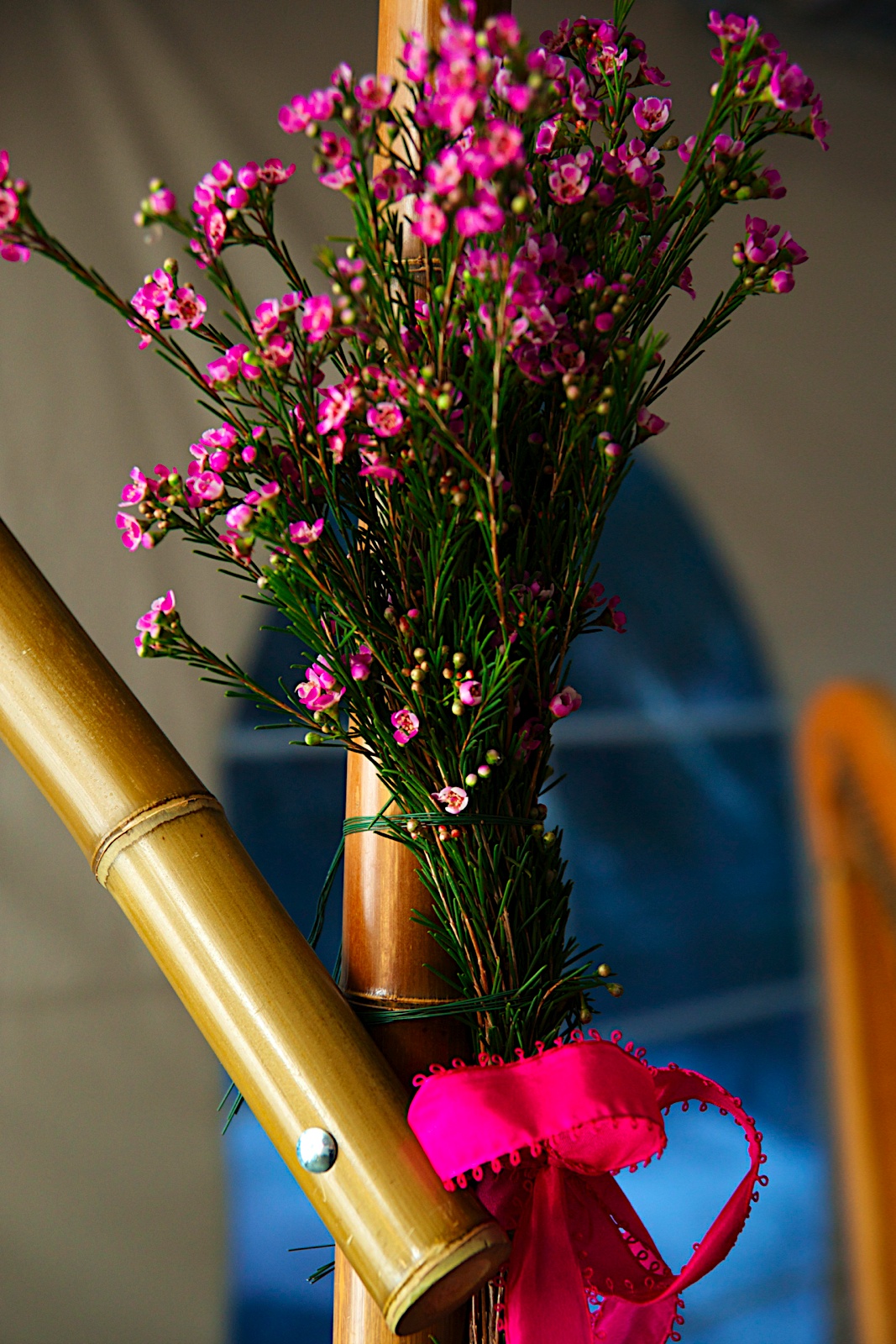
Thank you again for sending us the truly beautiful bamboo!  Here's the chuppah that my husband, Peter, constructed in Maine.  Then we transported it, along with our daughter's harp, to NYC, where the wedding took place at the New Leaf Cafe in Fort Tryon Park.  The chuppah had bouquets of flowers on the two front joints, but this picture was taken before they were attached.  If the official photographs have a good picture of the chuppah with its flowers, I'll send you that as well.  The covering of the chuppah was a tablecloth from the groom's grandmother, who died last year.  Peter got many, many compliments on the chuppah and it helped make the wedding even more special!

Thanks again!
Janet Rathbun (and Peter McDonald)



2/10/10

Using bamboo poles for interior decor


A customer from NC, Lexington Home Brand, used our 2” x 8’ polished black poles in a recent home show display.

Customers often ask, "Which bamboo poles should I use in a large vase inside my house?"

The answer is, "There isn't just one kind."

All of our bamboo poles – homegrown, imported, domestic-grown designer-quality - work well for interior décor. The key is deciding which type you like best. Your choice will depend upon the look you are after, your own personal tastes and aesthetic values.


Our homegrown poles are the most natural looking option. They are irregularly shaped and completely untreated. Homegrown poles are not as smooth as either the imported or domestically grown designer-quality canes nor are they as straight or even colored. Nonetheless, they have a rustic charm that works well in informal decors.

The imported poles are very traditional looking with smooth tan surfaces occasionally patterned with a natural patina. The imported poles tend to be very regular and straight although they occasionally bow outward and might have slight hairline surface cracks.

The domestically grown, designer-quality poles are the most finished looking. To achieve their smooth shine, freshly cut poles are dried in a low-oxygen high heat kiln. These poles are generally straight and crack-free although, like all bamboos, occasional fissures and bends sometimes occur.

Different types of poles as well as different lengths and diameter poles can be mixed together. Again, what you decide to use will depend on your personal tastes. Some people want all their poles to look similar while other people prefer a more irregular look with varying thicknesses of canes, different color finishes (like mixing black canes with the tan ones) and different length poles.


8/17/09

How do I divide off a section of a clumping bamboo?

A customer writes:
Hi, Sherry. I've been missing your column in the "Slantinel". They've been making so many changes in the last few months. Did you ever get a book published?

I have a question. I've got to move some of my bamboo; I made the mistake of putting some of it too close to other plants, and now I've got to make some room. I can see from your FAQ that now seems to be an okay time to do it, but what do I do, just dig it up and replant it? I was thinking of moving only half a clump to a new spot. Can I just slice down the middle, dig out what I want to transplant, and replant, or do I have to cut it back?

Thanks for any info you and Ralph can give me. All the bamboo I got from you is doing absolutely fantastic, especially with all this rain, and the seabreeze my daughter, Emily, put in has almost completely obscured the house next door.

Regards,
Dave


My response:
Hi Dave - My column only runs in the Lake County edition of the Orlando Sentinel now but you can read it online on my SIMPLY LIVING blog where I post new columns each Monday (you can sign up to be a FOLLOWER and receive automatic updates). I haven't gotten my book published yet but it is in the works.

You can certainly divide off a section of your existing clump but be forewarned: It ain't easy! Also, if you don't have to do it right now, it would be a little better if you waited until all the new shoots stopped growing and leafing out because any new shoots that haven't leafed out may not survive transplanting. Dividing during the late winter or early spring (before the new shoots emerge) is the ideal time to make divisions. Whenever you do it, it helps to use a sawsall to cut through the roots and to top the plants so only about a third of the top growth is left on the part you want to divide off. If you wet the ground down thoroughly before digging, it will make your job less difficult. After the section is divided off, make sure it is potted up and set in a shady place where it gets frequent watering to recuperate fully before setting back out into the ground.

8/16/09

I love getting letters from happy customers!

A customer wrote to say:
My father and I came to your nursery a couple times to pick up some bamboo and we found you to be very helpful. He had purchased bamboo from Kanapaha yearly sale and although that bamboo is doing well, the bamboo he bought from you is really sprouting shoots this year. Anyway, I just wanted to thank you for all your help and to let you know that your bamboo is very healthy. My father has purchased the Giant Timber, Dwarf Buddha, Blue, and Angel mist from you and they all have done extremely well this summer! See ya next year!!!

My response:
Thanks for writing! We're always happy to hear that our bamboo babies have found such a happy home. Although it sounds like your plants are doing just fine, it never hurts to add a top dressing of organic matter around the base of your bamboos. You can use any of a number of materials: compost, manure, grass clippings, peat, leaves, our bamboo booster mix or any combination of those materials. Unlike trees, which don't like to have soil supplements right up against their trunks, bamboos don't mind at all if the canes are surrounded by additions of organic matter. The nutrients from those materials will leach into the soil and feed the roots. The result will be more explosive growth and even healthier plants.

6/3/09

Is green bamboo good for building?

A visitor to our website wrote:
I love your website! I have a question. You mention that you have green, just cut, bamboo. Can you actually make fences, etc from green bamboo or do you have to wait for it to dry out? I’m just thinking that if I buy and plant bamboo, I’d like to know whether I could build furniture with it as soon as it’s tall enough. Thanks!

My response:
Freshly cut bamboo will turn tan as it dries and it dries rather quickly, usually within a few months. It can certainly be used for building when green but, like any wood, as it dries, there is shrinkage. If you use freshly cut bamboo canes you'll need to factor that into your calculations.

4/3/09

See for yourself how fast bamboo grows!


The three Seabreeze clumping bamboos above were planted 5' apart in May 2008 from 3-gal size plants. The hedge is now approximately 14' tall. When the bamboos were first planted in May, each plant was about 6' tall and only had one cane. When they were planted, the three Seabreeze looked similar to the two Seabreeze on either side of the sign pictured below (click on image to make it larger and easier to see):


Keep in mind that the bamboos in the top photo have only gone through one growing season. As the weather warms this spring, summer and fall, many new shoots will emerge growing to be taller and larger diameters than the existing canes. By the winter of 2009 our demonstration hedge will have formed an even more solid wall of green than it already is. By the same time, the bamboos in the photo below (which were planted in January 2009) will have gone through one growing season and will look just like the hedge pictured in the top photo.

How much is too much fertilizer and mulch?

A customer in Orlando asks:
I’ve been reluctant to put down a lot of pine bark so as not to interfere with new canes coming up. Am I being too careful? Inasmuch as I planted the bamboo November 1, am I being too careful in waiting til May 1 to apply Dynamite again? I don’t want to over-fertilize.

My response:
About the Dynamite, there's no need to fertilize again until May since the beauty of a time-release formula is that it emits a slow but steady amount of fertilizer over a six month period. As for the mulch, you can place a light mulch around the plants at any time. The new shoots will push through the mulch with no trouble. As the plants mature, you can add a thicker coverage. Mulches help plants retain moisture while reducing competition from weeds and adding some nutrients to the soil.

11/24/08

How Much Should I Water Newly Planted Bamboo?

Customer's Question:
What should be the daily watering schedule after the first 30 days? I've been faithful to the twice-daily watering, and the bamboo is doing well. If I can maintain the twice-daily watering for a second month or even through the dry winter months, would that be good, or would that be too much?

Answer:
I'm glad you've been giving the bamboo 2x daily watering during their first month. It will do them nothing but good to continue that pattern for the next few months while rainfall is minimal. Bamboos like water. The only time it is too much is if they sit in puddles of water for weeks at a time. Your plants will grow without regular watering but they will grow much larger and faster with a regular schedule like you are presently giving them.

9/30/08

How much room does clumping bamboo need?

A customer recently wrote:

We purchased some bamboo from you last year. We have a quick question about
GIANT TIMBER BAMBOO (Bambusa oldhamii). How big can we expect the diameter of the clump to get. Just want to make sure we have it in a large enough area. The Blue, Black and the Asian Lemon bamboos are all doing well! Will send pictures soon!


My response:

Like all clumping bamboos, Giant Timber will always continue to send up new shoots around the outer edges of the existing plant. That means as the years go by, the circle of bamboo will get bigger and bigger. When you think it's large enough, vigilantly chop off or knock over the new shoots when they emerge in the late spring/summer. Once a new shoot is broken like that, it will stop growing.

If you're afraid the spot where you've placed the Giant Timber will fill up too fast, moving it would be a good idea. But, if you can, wait until December or January to do transplant. By then, all of this year's new shoots have completely grown up and leafed out. Moving a bamboo when it still has young canes often prevents the canes from continuing to develop and results in a loss of potential growth for those particular canes. Also, to make it easier to dig up the bamboo, the night before you plan to move it, thoroughly soak the ground around the bamboo. Wet ground is much easier to dig through.